For those who don’t get the RSS feed from our news section, we published a news release about our participation at CeBIT 2012. You’ll find some messaging, product specs and also selected new 7 series motherboard pictures in that announcement.
Wednesday, March 7, 2012


GIGABYTE’s future 7 series motherboards – worth the upgrade!
This week we uploaded our 7 series mobo microsite that includes all of the features and technology available to you if you upgrade from your Z68 or older GIGABYTE motherboard to a new Z77 or H77 series board.

Two key features are GIGABYTE’s 3D BIOS and 3D Power that brings our dual UEFI BIOS and All Digital Power technologies to the socket LGA 1155 platform. 3D BIOS has a 3D mode that’s easy enough for everyone to use, while also boasting an advanced mode for overclockers and other advanced users. Here’s a screenshot of the new 3D BIOS in 3D mode:

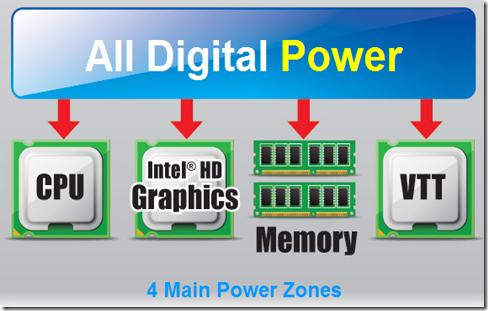
3D Power offers maximum control over the power to the four main power zones that are the CPU, processor graphics, memory and VTT. There is more information about our 3D Power utility on the 3D Power web page.
These 7 series mobos also see the introduction of a new dual band WiFi + Bluetooth 4.0 card that will go a long way towards making your desktop PC the center of your personal cloud.

And then there is also the widespread adoption of Ultra Durable 4 and other GIGABYTE motherboard technologies such as 1 fuse per USB port, On/Off Charge, 3x USB Power and mSATA onboard.


A list of models that will be available globally can be found in the ‘Models’ section of the microsite.
Of course, there are a lot of new technologies missing from this microsite, in particular those that will be unlocked by the new 3rd Generation of Intel® Core™ processors that will available in the spring (northern hemisphere) of 2012. Stay tuned for more updates from CeBIT where Stew is manning our booth and demoing these new technologies.
TeamAU & GIGABYTE join forces to freeze over Perth in an upcoming GIGABYTE eXtreme OC workshop!
Atomic Magazine just made an announcement that they are taking registrations for the upcoming GIGABYTE eXtreme OC workshop. Be quick or be gone!

Do you want to learn the ins and outs of extreme, sub-zero overclocking? Do you want to learn from the best overclockers our country has to offer? Do you live in Perth?

Well, it's soon going to be your lucky day!
GIGABYTE's hosting an Extreme Overclocking Workshop on the 25th of March - this month! - and 12 lucky Atomicans can come along and take part. The workshop's going to be run by OC veterans TeamAU, Australia's best overclockers. These guys regularly compete on the international overclocking stage, and are a great bunch of lads to boot.
Thanks for the event sponsors for making it all possible


For more info on the event visit ATOMIC or OCAU forum.
Tuesday, March 6, 2012
Lab501 showing off some new GIGABYTE boards, that UD5 is looking good!
Lab501 guys are at CEBIT 2012 and got ahold of some happy snaps from GIGABYTE booth.
Some of he highlights include the new G1 Sniper3 and X79S-UD5. Full coverage can be found here.


Wednesday, February 29, 2012
GIGABYTE team up with TweakTown to give boards away!

TweakTown are giving away a pair of GIGABYTE boards this week in their aptly named Weekly Giveaway Competition. The catch? Well it’s all actually rather simple and straightforward; just head over to the TweakTown Facebook page, hit up the old ‘Like’ button, write this comment “I want to win one of two new GIGABYTE motherboards at TweakTown!” and you’re done for the day. Sit back and count down the hours til our buddy Cameron announces the winners on March 5th next week.
The prizes are a Sandy Bridge-ready Z68XP-UD3, and a Llano toting A75-UD4H motherboard. How could you possibly resist?
Check out the competition page here on the TT forums.
Christian Ney SMASHES the global memory frequency world record with GIGABYTE A75-UD4H!
You don’t see this every day I must say. Overclockers push their systems so hard to reach the ultimate frequency and give it absolutely every last bit of “juice” and cold to extract the most they can out of their hardware.
Christian Ney from Switzerland did a remarkable job yesterday smashing the global RAM frequency on the Llano based GIGABYTE A75-UD4H. Yes that’s right, he beat the big boys (with their 990FX boards) using a GIGABYTE Llano board which are meant to be low end.
Now that’s overclocking!!!

Christian did a writeup on OCAHOLIC website, check it all out HERE and HWBOT submission can be found HERE

Final result was a RAM frequency of 1868.3MHz (DDR3-3737) FAINTS!!!


Congrats man, you are killing it right now!
Tuesday, February 28, 2012
GIGABYTE Spring Extreme Competition is heating up
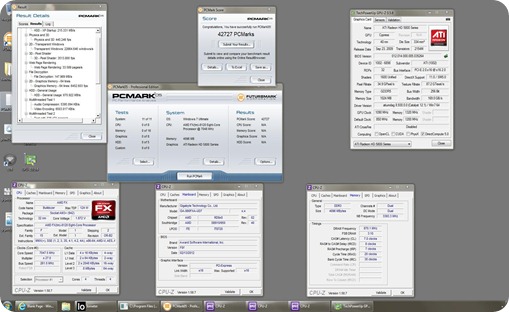
I.M.O.G from USA just broke the 8 core CPU PCMARK05 world record while benching for the HWBOT’s GIGABYTE Spring Extreme Competition. He used a GIGABYTE 990FXA-UD7. He forgot to use the competition screenshot guidelines in all that excitement and promised to come back with an even higher score. I like that! hehehe
Check out the competition HERE
Check out the world record score HERE

Friday, February 24, 2012
Lucid Virtu MVP: What it is, and why you’ll want it on your motherboard

One of the real standout features of our Z68 series motherboards, was the inclusion on Lucid’s Virtu software on several models. For those of you who are new to Lucid Virtu, the elevator description would be that …“it basically allows you to switch between your onboard graphics and your discrete graphics card”. HHmm… and why exactly do I need that?
Switchable Graphics
Well there are a few reasons. The main benefit from this ‘Switchable Graphics’ feature, is that you can power down your graphics card when running less GPU-intensive 2D tasks like web browsing, watching video and general purpose productivity tasks, but then engage the discrete card when you need it, i.e. when cranking up your favorite 3D games.
One of the more obvious benefits from ‘Switchable Graphics’ is that today’s discrete graphics cards tend to consume a lot of power, adding significant wattage to your PC’s overall power consumption even while idling. Being able to switch off the discrete card when it wasn’t needed offers a tangible reduction in power consumption, and perhaps most significantly, a tidy reduction of your electricity bills too.
Other benefits included having access to Intel Quick Sync technology, a popular feature that discrete graphics card users would typically have to abandon, as Intel’s Quick Sync is a processor-bound feature that required you to use Intel’s processor graphics. With Lucid Virtu’s Switchable Graphics feature you could essentially have your cake and eat it too; want super fast video encoding thanks to Intel Quick Sync? No problem, select processor graphics. Want great 3D performance for your latest DX11 games? Switch to that monster card you paid all those dollars for…
Now you’re probably saying that this is old news, but there is a new feature in MVP that gives you control over whether to use processor graphics or the discrete GPU for each application. Here’s a peak at what it looks like.

But wait, there’s more to come..
However, since the Z68 launch, I’ve come to the conclusion that Lucid’s first iteration of their Graphics Virtualization software, Lucid Virtu, was actually just the beginning. Here was something that would grow, gathering momentum to quickly become a ‘must have’ feature for DIY PC builders and PC gamers. Having recently spent some time with the good people from Lucid, I’m now more excited than ever.
Here at GIGABYTE we’ve been working with Lucid to bring the latest Virtu MVP technology to our new 7 series motherboards. Trust me when I say that this is going to be popular bundle, and that’s because while Lucid Virtu MVP has the same switchable graphics feature that I describe above, they’ve also added new technologies that make it truly a game-changing feature (excuse the pun).
Virtual Vsync
If you’re using a powerful graphics card you may find that you’re getting some amazing frame rates at times, especially if you’re playing slightly older 3D games - many DX9 titles like Left4Dead and Portal 2 for example are still very popular. Today’s midrange and enthusiast graphics cards can rip through those games with blistering frame rates.
However, one problem that will arise with really high frame rates is that your monitor will almost always be limited to a refresh rate of around 60 Hz (can be equated to 60 frames per sec/FPS). Now if your game is running at 90FPS or more, this frame rate mismatch can result in a phenomenon known as ‘Tearing’. Check out the door frame and mirrors in the image below. You’ll see how tearing can look within a game. Not exactly the best graphical experience.

Most games offer a fairly clumsy solution to the problem, euphemistically referred to Vsync. If you enable Vsync within your game’s settings, the game will basically limit frame rates to be equal to that of your display – typically 60 FPS. This will result in a wholly inferior game experience. Frame rates of 80 and 100FPS are very much preferable. Most gamers agree, Vsync is a solution that can prevent tearing, but alas, at a significant cost.
Virtual Vsync however is a much more sophisticated solution which resolves the tearing problem, but crucially, without limiting the frame rate. In fact, Virtual Vsync delivers almost the same frame rate as you originally experienced. Again, Lucid has found a solution that means you get the best of both worlds. Fast frame rates of 100 and above, without tearing.
HyperFormance
The other new feature that we’re looking forward to offering you guys is what Lucid refers to as HyperFormance, a feature which claims to substantially improve overall 3D gaming responsiveness. By responsiveness we mean how well the game actually responds to your mouse and keyboard, a key factor that contributes greatly to a better overall gaming experience.
Without getting too technical, Lucid Hyperformance basically examines each piece of data as it passes through the graphics pipeline with the aim of eliminating redundant rendering tasks. This allows for shorter rendering cycles which, in turn translates into better overall responsiveness for you the gamer. We have toyed around with Hyperformance here in our labs, and we’ve been impressed at how the game just feels faster. If you were running at 100FPS, enabling Hyperformance will most likely give you even higher FPS. Not only does the FPS show marked improvement, but so too does the feel and responsiveness of the game.
A Bundle Worth Waiting For
Although at the moment we can’ talk about when our 7 series boards will hit the market, we can tell you that when they do, many models will come bundled with Lucid Virtu MVP. We’re really looking forward to that day, and we’re convinced that this new platform will be a big hit with casual and enthusiast gamers who want to enjoy the best 3D gaming experience possible.
Really cool GIGABYTE mobo warranty checker
I was just helping our India marketing team with some English text for their support website and came across this really easy to use GIGABYTE motherboard warranty tool: http://ggcs.gigabyte.com/service/CheckWarrantyStatus_IN.aspx.

Simply type in the serial number on the retail package of your motherboard (include the full serial: e.g. SN111900003001), and select the country where you bought it.

After clicking on the ‘Submit’ button it should tell you what motherboard you have, and how much time you have left before the warranty runs out. You can see from the screenie below that they P67A-UD7 that I’m using is under warranty until April 24th, 2014.

Enjoy! Let us know what you think of this tool on our facebook page.
Wednesday, February 22, 2012
Overclock 3D give away GIGABYTE-based rigs in 2012 Competition MADNESS!

Tiny Tom Logan at overclock3D.net is running what has now become an annual event with his 2012 Competition Madness. He’s giving away three fantastic enthusiast systems that feature the GIGABYTE G1.Assassin 2, X79-UD3 and Z68XP-UD4 respectively. The competition is open to people of all regions of the world and simply requires you to submit your email address and sign up for a monthly newsletter. What could be easier? Competition closing date is Feb 28th, so you have about 6 days left…
Whet your appetite and check out the specs of the 1st Prize:
Custom BitFenix Collosus
Gigabyte G1 Assassin 2
Intel i7 3960X
Kingston HyperX 2133MHz 16GB
Kingston HyperX 120GB SSD x2 in RAID-0
Enermax Platimax 850w PSU
GTX580 Graphics Card & 27" 3DV2 Monitor
XSPC CPU & GPU Watercooling thanks to www.specialtech.co.uk
Here’s Tom being his effervescent self, running through the details and prizes, as ever on video:

Visit the competition page on Overclock3D.net here and submit your entry!
Subscribe to:
Posts (Atom)