Tuesday, February 21, 2012

3D BIOS and 3D Power impress UMLAN.com in X79-UD3 review

IMG_0996

UMLAN.com have published an interesting review of our X79-UD3 motherboard. The GIGABYTE X79 series launch saw the debut of our new 3D BIOS and 3D Power technologies, so it’s great that reviewer Alex Lusakhpuryan was impressed with what he saw during the review:

“The software which is provided by Gigabyte give you a complete control of your system from OS and from BIOS. Two signature features in GA-x79-UD3 is the 3D BIOS and 3D Power. With 3D BIOS you have a GUI based BIOS which comes in handy for adjusting setting. It comes extremely handy for pro overclockers who want to push their system beyond limits and GA-x79-UD3 is certainly capable to provide a wide room for overclocking. 3D Power application is designed for overclocking. With this tool you can easily adjust Voltage, Phase and Frequency which are crucial in obtaining best and stable performance. Along with 3D BIOS and 3D Power Gigabyte offers other monitoring and overclocking tools from the OS.”

Alex concludes the X79-UD3 review by giving it a 9/10 rating:

“Bottom line is, if you are looking for a motherboard which would satisfy every user from pro IT to pro gamer then GA-x79-UD3 just might be it. GA-x79-UD3 is comfortably priced against its competitors MSI and ASUS and offers amazing performance. Does it worth 269$? In my opinion it does absolutely! With all these great features and 5 year warranty, how can you go wrong?”

b_400_400_16777215_00___img_awards_9

Check out the full review here on UMLAN.com

More details about the X79-UD3 can be found on our website here.

Monday, February 20, 2012

The BIG Freeze is coming to UK!

Nope, not the ice age guys, GIGABYTE is sponsoring an overclocking event of course!!!

HiVizMan from OCN forum recently made an announcement about a really cool overclocking event to be held at Cambridge (UK). If you are from UK or other parts of the world for that matter, and want to be part of something awesome, do yourself a favour and click on the link and organise a trip to Cambridge during the 2 day event (March 17th – 18th).

cambridge-poster

…hmmmm, I didn’t know Hugh Jackman was into overclocking. How cool!

Have fun guys, wish I could be with you all!

Open-mouthed smile

Tuesday, February 14, 2012

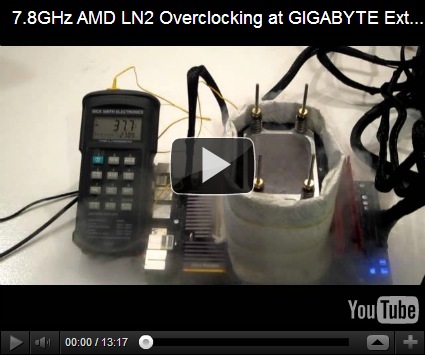
Video: TweakTown’s Deanzo shows us how to crank an FX-8150 Bulldozer to 7.78GHz on LN2

Armed with a GIGABYTE 900FXA-UD7 motherboard and a few liters of liquid nitrogen, Dean ‘Deanzo’ Smith shows us on video what it takes to cool an AMD FX-8150 processor all the way down to minus 180 degrees Celsius and hit incredible clock speeds in excess of 7.7GHz. You have to take look at this video; it’s great to get an experienced overclocker showing us step-by-step how to insulate the motherboard properly, patiently pouring in the LN2 until you get the desired CPU temperature.

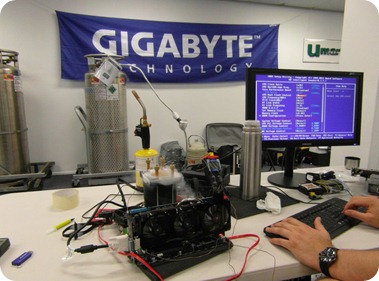
Interestingly Dean recently took part in a GIGABYTE Extreme OC Workshop in Brisbane Australia where pros like himself and our very own Dino gave enthusiasts a chance to get hands on with LN2 overclocking. You can read Dean’s report on the event on TweakTown here.

4558_2_7_8ghz_amd_ln2_overclocking_at_gigabyte_extreme_oc_workshop_full

You can click here to learn more about the GIGABYTE 990FXA-UD7 featured in the video above.

Friday, February 10, 2012

GIGABYTE and CyberPowerPC team up to protect your Intel CPUs from Overclocking mishaps

cyberpowerpc-system

Here’s some great news about a partnership with ourselves and CyberPowerPC where customers can get an Intel Performance Tuning Protection Plan absolutely free when they purchase a CyberPowerPC using any ‘K’ or ‘X’ model Intel processor and a GIGABYTE Z68 series motherboard. This is great news for anyone who fancies getting getting a kick-ass, handmade PC that they can push to the max.

Here’s the press release:

GIGABYTE Partners with CyberpowerPC to Offer Intel’s Overclocking Warranty Plan
--Push your CPU to the Limit with the Performance Tuning Protection Plan--

City of Industry, California, February 09, 2011--GIGABYTE TECHNOLOGY Co., Ltd, a leading manufacturer of motherboards, graphics cards and computing hardware solutions announced today that it has partnered with leading gaming PC system builder CyberpowerPC, to offer Intel’s Performance Tuning Protection Plan free. Purchased systems configured with the “K” or “X” Intel boxed CPU along with GIGABYTE Z68 series motherboards will qualify.

The Performance Tuning Protection Plan being offered by Intel is a chance for users to experiment with the overclocking features of your processor without the worries of what will happen if you push the processor too far. GIGABYTE and CyberpowerPC are teamed up to bundle Intel’s Plan free of charge, and allows you a single processor replacement through CyberpowerPC’s customer support if the CPU fails while running outside of Intel specifications.

For those who desire to obtain greater performance of the CPU by overclocking or tweaking the voltage, the GIGABYTE Z68 series motherboards with their new redesigned VRM, promise to deliver first class system performance and power stability. With only the best quality components and unique design, incorporating Dual Power Switching and Power Phase Boost with Multi-gear Switching, your CPU can enjoy more unadulterated power from the motherboard than from previous motherboards.

To find out more information about GIGABYTE Z68 series motherboards, please visit: http://www.gigabyte.us/MicroSite/279/z68.html

www.cyberpowerpc.com

Thursday, February 9, 2012

AMD announces new sans-GPU Llano chips. But where did the GPU go? And Why?

A CPU not an APUAthlon_II_X4_Box

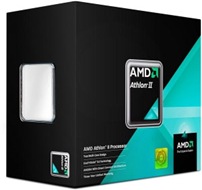
AMD just announced a bunch of new processors that are based on the Llano architecture but are in fact branded Athlon II. This might sound a little odd at first, as Llano was launched in June of last year as AMD’s new APU processors - combining x86 CPU cores with a dedicated DX11 GPU. What we have here however with the new Athon II X4 638 and 641 models, are pretty much traditional CPUs, i.e. no built-in graphics, just four x86 cores.

This is very similar to what Intel did earlier this month, launching several Sandy Bridge processors that also didn’t feature integrated graphics. So what’s going on? How have these processors come to be on the market without graphics, when in both cases they belong to an architectural design that dedicated significant transistors to providing a unified CPU plus GPU design?

Not all Chips are Born Equal

Well firstly, it’s important understand how these chips are made. The truth is that semiconductor fabrication is more like growing fruit or baking bread than you’d think. The silicon wafers that are produced are, for the sake of analogy, essentially grown. As with all things that are grown, the end products are not always born equal. In fact all processors undergo a binning process once they are produced. This process assess whether the chip is a Core i7 2500k, a Core i3, or perhaps an entry-level Celeron part. Some processors come off the conveyer belt with blinding performance, others may not work so well at all. When we talk about silicon wafer yields, we’re essentially describing how efficient the fabrication process is. High yields mean more fully functioning chips per wafer. Lower yields means fewer.

But regardless of yields, there will always be some chips that are born with imperfections – indeed few arrive in immaculate shape. If Intel or AMD are manufacturing quad-core processors, the chips that have imperfect cores will often have some cores simply turned off – thus a dual-core processor is born. AMD even markets tri-core processors where only one of the four cores is sub-standard. Well why not? Three cores are better than two.

Chips-big

It would seem that both Intel and AMD have decided that those processors that happen to have sub standard GPU parts, will now also be binned as CPU-only models. The new Athlon II X4 638 for example is basically a full Llano processor that has it’s malfunctioning GPU turned off. That’s not actually as bad as it sounds. It makes perfect for AMD to do this.

The GPU that’s integrated with Llano APUs uses significant power. This power will doubtless have affect how how high the CPU can be clocked. By turning off the GPU entirely, AMD should be able to squeeze a touch more performance from the CPU part, or perhaps be able to reduce the overall power consumption of the CPU (hence the Athlon II X4 638 has a reduced 65 watts TDP). The bottom line is that these new CPUs from AMD and Intel are no worse off for having their graphics removed or turned off, in fact they may perform better as CPUs without the GPU.

So Who’s Buying these Chips?

It’s also important to realize that there is a significant market for this kind of CPU. Many customers will demand a dedicated graphics card in their system and will not care so much about having integrated graphics. AMD’s pricing reflects the fact that you’re only getting a CPU not an APU (i.e. CPU plus GPU), so from the customer’s perspective, why not save a few dollars. If you don’t need an the integrated GPU part, why pay for it?

Here’s a situation that serves as an example from a System Integrator (SI) perspective. There are a select few GIGABYTE motherboards that support Sandy Bridge, but don’t in fact have onboard display connectors. Branded as GIGABYTE P61 boards, these motherboards support Sandy Bridge processors via an Intel H61 Express Chipset, but unlike all other H61 models. do not have any onboard D-Sub or DVI connectors for a monitor or display. Let me explain why.

One of the primary markets for these boards is China, specifically the Internet Cafe market in China. It’s a massive segment and its one that’s increasingly important. Our P61 boards are essentially designed specifically for Internet Cafes in places like China where the demand for integrated graphics is virtually nil. These customers know that they will be using a discrete graphics card, (gamers in China demand it) and they want boards designed specifically for that purpose. i.e. they want the affordable H61 chipset, but they don’t want to pay for a board with onboard video support – yes, adding VGA, HDMI or DVI connectors cost money and raises the price.

However, these kinds of markets still want good CPU performance, but of course without the integrated graphics that we find in Llano and Sandy Bridge. So you can see how these new processor models from AMD and Intel will do very well in these kinds of markets.

china-internet

Intel and AMD realize that greater integration from an architectural stand point is essential to the future of x86 processor design - raising efficiency and performance (it’s also essential if they’re going to compete with ARM, but that’s a story for another day). But while integration makes perfect design sense, from a strictly business perspective, it also makes perfect sense to increase your yields while also offering niche markets a product that fits perfectly for them.

Finally, from a strictly DIY perspective, these new CPUs will also mean good value to certain PC builders. If you’re building a mid-range or even budget system and you know you’re going to use a graphics card (i.e. you want better than ‘APU level’ 3D performance, or perhaps you already have a graphics cards from a previous build), the new Athlon II X4 641 at $81, may well be the perfect fit for you.

Stone Cold Computing: a journey into overclocking

PC & Tech Authority magazine recently published an article in print and online about “a journey into the weird and wonderful world of sub zero overclocking”.

0_450_665_http---i.haymarket.net.au-Galleries-20111129120020_SAM_0062

John Gillooly, article author, is no stranger to enthusiast scene being the hardware geek and virtuoso behind some of the best known magazine names in Australia since their inception just about.

0_450_665_http---i.haymarket.net.au-Galleries-20111129115947_SAM_0049

John joined in on a fun trip with GIGABYTE and TeamAU boys who set out to share their overclocking knowledge with the up and coming enthusiast in Brisbane, Australia. John gives subzero overclocking a different perspective, definitely a worthwhile read!

One of the quotes that stood out was “Overclockers are often where our old review products go to die.” LOL

20120209031500_overclock 1

You can read the article here.

Wednesday, February 8, 2012

Video: Elric gets romantic with our GIGABYTE X79-UD5

Elric from Motherboards.org is certainly known for his musical abilities, having his own rock band and such. His musical, er… abilities, don’t stop there however. as I’m sure you’ll agree if you watch the video below where you’ll witness Elric doing an unboxing of the GIGABYTE X79-UD5 motherboard with a rather special (if slightly creepy) musical introduction.


Cheers Elric. Unboxings can kind of get boring to do I’m sure. We’re giving you 10/10 for creativity buddy.

We look forward to the full review on Motherboards.org

Learn more about our X79-UD5 motherboard right here.

Monday, February 6, 2012

Overclockers Rejoice! APC enjoy the GIGABYTE X79-UD7

5305_big

James Trevaskis, writing for APC magazine, has just published his review of our X79-UD7 motherboard.  Giving our high-end X79 board a healthy 9 points from 10, he takes time to praise our designers for creating one of the more interesting X79 designs on the market as well as acknowledging the UD7’s overclocking DNA and direct lineage to our uniquely positioned X58-OC board. James appreciates how much effort has also gone in to creating a board that simply ‘screams’ overclocking:

“The 4G button makes overclocking impossibly easy: simply throw in your CPU, memory and graphics card, then press the 4G button for an instant 4GHz overclock. The OC Touch interface makes a welcome return, providing buttons to adjust your CPU multiplier and base clock on demand, without ever entering the BIOS. In a major step forward, GIGABYTE has moved away from analogue power circuitry and added a new digital PWM that promises to deliver cleaner power and more control to the user. The BIOS has also had a major overhaul, taking the UD7 into the realms of the graphical BIOS. Never fear though, the old BIOS layout is a single click away at all times.

GIGABYTE has come through with another great motherboard in the UD7; while it doesn’t have as many features as other ultra-high-end boards, it's extremely competitively priced. We don’t care what GIGABYTE calls their motherboard, around the APC labs it will be known as the X79-OC.”

Catch the full review here at APC Magazine.

Click here to find our more about the X79-UD7 motherboard.

Wednesday, February 1, 2012

Wow, what a great comp! Christian Ney smashes all Llano records to oblivion!

HWBOT.ORG’s competition called GIGABYTE X'MAS & New Year Contest just finished with Christian Ney from Switzerland absolutely smashing all scores in style.

 723469720630

Hardware used:

  • GIGABYTE GA-A75-UD4H
  • AMD A8-3870K 'Llano' CPU
  • Geil Eva Corsa RAM
  • Both RAM & CPU Cooled with LN2

Records achieved:

  • World Record Llano Reference Frequency at 200MHz
  • World Record Llano Memory Frequency at 1752.8MHz & 2nd highest overall global RAM frequency achieved! WOW!!!
  • World Record Llano CPU Frequency at 6067.71MHz (also well done to Tsunamijuan and _mat_ for reaching past 6GHz :)

Overclockers are super-nerds and what better way to express happiness than to load up some old school MC Hammer in your submission posts, love it. Christian Ney says… U Can’t Touch This

Hammer time

Tuesday, January 31, 2012

Sin0822 gives us his take on the G1.Assassin 2 motherboard

2

Respected power user Sin0822 has once again turned his attention to our new X79 platform with a review of our GIGABYTE G1.Assassin 2 board. As you’d expect from a Sin0822 review, it’s very detailed and covers just every aspect of the board including details on pretty much every chip we used. There’s also advice on how to achieve a good overclock, as well as some proof that Sin can handle himself in the 3D gaming realm and is well placed as a reviewer of high-end gaming offering. Here’s a sample of what he has to say:

“The G1 Assassin 2 is a 3rd generation G1 Killer. It’s a gaming board, but the best of the best gaming boards. Sure other boards might have some overclocking features like buttons, voltage read points, and cool sub-zero temp meters but what gamer is ever going to use those while gaming? I am not saying that this board doesn’t overclock, it in fact does overclock great, but it is more geared towards gamers and thus you only pay for gaming features.

"Shouldn't a gaming board be reviewed by someone who actually games?", some have asked. Many might not know this, but I do in fact play some computer games, and I can show off a bit below. In the end this board is now in my 24/7 rig displacing the Sniper 2 into my second rig, and I really don’t game with anything other than a G1 series board. There is a reason to this, because I have my 24/7 computer on 24/7, it doesn’t sleep, it miss a beat either, it just runs. I feed it electricity, and yet I depend on it to do everything. I must say though that nice audio allows me to hear around corners, as I can hear footsteps and that is one of the biggest advantages to a G1 board. Of course a top-notch sound card can do the same, but I never bought a sound card after my Audigy2 ZS.”

You can catch the full review on several of the sites and forums Sin frequents: XtremeSystems, Overclock.net, Overclockers.com, Overclockers.com.au, Tweaktown.com

More on the G1.Assassin 2 can be found here.