15 more minutes till showtime


Location:JīnShān North Rd,Jhongjheng District,Taiwan

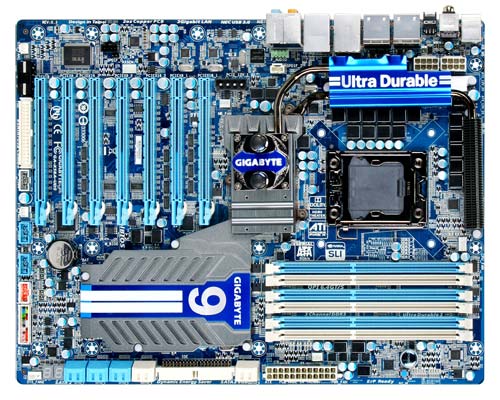
Sean from TweakTown recently checked under the hood of GIGABYTE’s latest performance powerhouse motherboard, the GA-X58A-UD9, to find out what all the buzz is about and to discover what makes it the undisputed fastest motherboard on the planet.
The GIGABYTE X58A-UD9 is one very impressive board, even if for nothing else than its size and potential for massive overclocking and GPU performance. If you are looking for your next record breaking motherboard, this one is probably it!
we can honestly recommend this board not only for the audacity of its design, but also for the potential performance that you can get from it.
To read the full review, be sure to visit TweakTown at GIGABYTE X58A-UD9 (Intel X58 Express) Motherboard.
For those readers who are using a GIGABYTE H55N-USB3, how did you built your fancy system with this board? Something that interest me most about this motherboard is the small size and its amazing performance which makes it a perfect solution to build a sleek looking HTPC,and had made me to think about the possibility of doing a case mod by myself (of course with the help of my associate – Janus who had done most of the hardwork).
Before we started, we had several discussions about what components should we use, what sort of materials to use for doing the case mod. We definitely need an extremely small motherboard but with extreme functionality for building up a mini HTPC like this. So GIGABYTE H55N-USB3 is a very good choice. With onboard integration of super speed USB 3.0 interface and GIGABYTE Ultra Durable3 design, the GIGABYTE H55N-USB3 provides better data transfer efficiency and longevity and stability to meet the power need. And we are using an Intel Core i5 530 processor which support high quality video out putting and it is also the best choice for gamming.
We have use a 2x 2GB DDR3 memory in total of 4GB of RAM, 80GB SSD harddrive for system OS. Also for the media center Demand, we installed a Bluray DVD-ROM underneath the motherboard. In order to fit in all the things in to this color box we have bought a 150W mini power supply from a car electronics store. As for the chassis, we decided to spend the least amount of money for building the chassis by using the packing box of H55N-USB3 in which we don’t have to spend any dollar for that.
So lets take a look how did we build the GIGABYTE H55N-USB3 HTPC from scratch.
 |
| Getting stuffs ready for building the HDD and DVD-ROM base platform |
 |
| Cutting the outlines and screwing the cut-out in place |
 |
| SSD Hard drive and DVD-ROM fits nicely at the bottom |
 |
| Placing the screw mounts, cables and the motherboard |
 |
| Marking the opening for the back-panel I/O |
 |
| Cutting the openings for rear-panel and power supply’s cooler fan outlet |
 |
| Cut outs of the H55N-USB3 packaging box |
 |
| Placing the power supply’s cooler fan |
 |
| Placing the rear panel I/O plate |
 |
| Placing the power / reset switch |
 |
| Tightening up the motherboard |
 |
| Tightening up the power supply |
 |
| Placing the 20pins power connector |
 |
| It’s done! |
 |
 |
 |
 |
 |
 |
 |
| Connecting to the monitor with a HDMI cable and Powering up |
 |
| Here’s a quick test for the performance |


The GIGABYTE GA-H55N-USB3 continues to make waves in the small form factor computing arena. Jeff from the Tech Report recently got his system building hands dirty with his latest Mini-ITX build featuring GIGABYTE’s little Mini-ITX that can and Silverstone’s SC07 shoe boxed sized case.
The Mini-ITX form factor has long been a viable platform for low-power desktops and home-theater PCs, but it's never been particularly friendly to high-performance gaming rigs. Today, however, we've proven that you can build one heck of a midget gaming system with Gigabyte's GA-H55N-USB3 motherboard and Silverstone's SG07 chassis. In fact, the case and mobo have enough headroom to accommodate an even more powerful system than the one we cobbled together.
To read the full review, please visit: http://techreport.com/articles.x/19641
Jeff’s article also got picked up by Engadget: http://www.engadget.com/2010/09/21/gigabyte-h55-mini-itx-motherboard-and-silverstone-sg07-used-to-b/

Good news for Polish readers, we now have a Polish subtitle option on videos in the MoboTV youtube channel. The first video to feature the Polish subtitles is the GIGABYTE Quick Charge video in the picture above. All you have to do it put your curser on the red CC button and the subtitle options will pop up fro you to select your language of choice.
Leave a comment below if you want to see your home language as a subtitle option on future MoboTV videos.
It was another busy week for us at GIGABYTE. While we’re in the final stages of preparations for GO OC 2010 Global Finals coming up this weekend, my associates Tim and Colin were at the other part of the world participating the Intel Developer Forum (IDF 2010) at San Fransico showcasing our upcoming products at the USB Techzone.
So if you are interested and wanted to get a sneak peek of GIGABYTE upcoming motherboards, please check out the following links from the media coverage.
Youngpro put up a couple of world records on XS with a GIGABYTE X58A-UD3R in PCMARK 05 & VANTAGE. Congrats!
Quotes from James:
The Gigabyte UD3R is a really nice little board. I picked this board because it is what I need for this bench, offering all the functionality of a UD9 (of course with not as many PCIE slots) and not a huge amount going on with the board. This is important when there is so much going on with the raid array and the rest of the setup.
Areca 1280ML is a legendary raid controller, it is unpeered in all the benchmarks we play with, and has been for years. I have tried raid controllers from 3 other vendors and my scores can no touch this raid controller. If you want to win at pcmark, you need ARECA.
http://www.xtremesystems.org/forums/showthread.php?t=259365

PCMARK VANTAGE
http://service.futuremark.com/compare?pcmv=364293

PCMARK05
http://service.futuremark.com/compare?pcm05=2332198

[EDIT] – Fight for PCMV has just intensified some more with SteveRo from XS breaking back the PCMV W.R. with a GIGABYTE X58A-UD7 and 7x ACARDS.
Go OC 2010 worldwide final is just over a week away! GIGABYTE team and judges have done some bios testing and troubleshooting to provide a solid bios for the finals. We are going to release this bios in public today for competitors and media to review and use before the finals if they wish to. It will be accompanied by a guide and some handy voltage read points for GA-X58A-UD7 (rev2.0) motherboards which form part of the competition OC gear platform.
Here is the summary of changes and features provided with this competition bios:
BIOS NAME: GOOC 2010 WWF
Download link: http://rapidshare.com/files/419207367/GOOC2010.W08
Alternative download link: http://filefactory.com/file/b370d02/n/GOOC2010.W08


Measurement points if necessary:
DDR voltage and CPU vcore voltage closely correspond to values set in bios. QPI/VTT undervolts between 0.08v (1.4v in bios was 1.32v on DMM) at lower volts and up to 0.1v at higher volts(1.69v in bios was 1.59v on DMM).


One of the key performance aspects the bios was tested for is 32M SuperPi as it is one of the benchmarks which will have a strong impact on the competition. The bios is very efficient as per this 4Ghz test. NB clocking on this particular CPU was also solid clocking to 5.2Ghz 32M stable NB frequency in a separate test which may benefit some of the benchmarks chosen for the final.

If you would like to read Spanish (Español), Chinese (中文), or English sub-titles while watching GIGABYTE Cloud OC and Hotkey OC videos, click on the red CC button and select the language of your choice. Future videos will be available with more language sub-title options so leave us a comment if you’d like to see your home language sub-title option.

Memory overclocking is getting more exciting by the day on XtremeSystems.org. An overclocker from Austria (no kangaroos there) called _mat_ posted an impressive overclock with the GIGABYTE P55A-UD7 and Corsair GTX6 memory to a new CAS7 latency world record of 3059.4Mhz. He also managed to beat a recently set CAS8 record. For more info visit XtremeSystems forum.


